
The Exposure Ladder That Actually Works for Social Anxiety
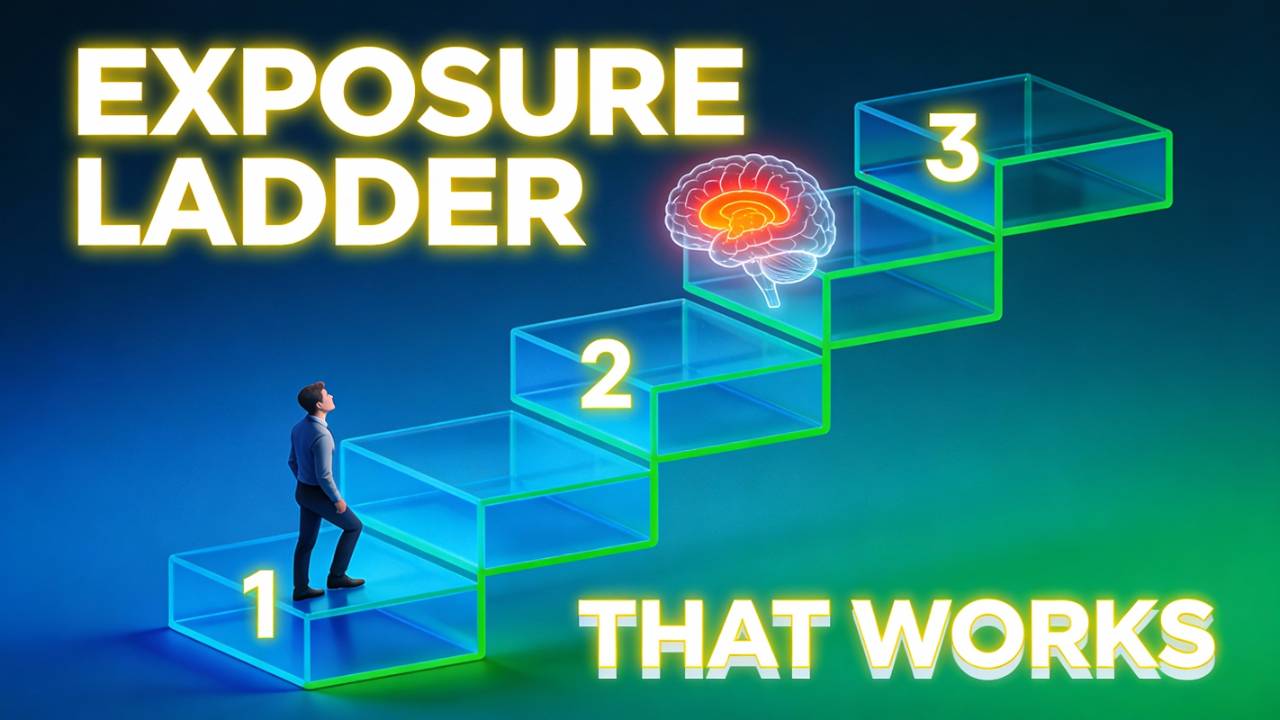
If you've ever tried exposure therapy for social anxiety and felt like you were just torturing yourself without getting better, you're not alone.
About 12% of people will experience social anxiety disorder in their lifetime, making it one of the most common anxiety disorders. And while research shows that exposure therapy has a tremendously high success rate when done properly, most people attempt it incorrectly and end up more discouraged than when they started.
The problem? Standard exposure hierarchies completely ignore how social anxiety actually works in your brain.
Why Standard Exposure Ladders Fail
Most exposure hierarchies you'll find online tell you to start small – maybe making eye contact with a stranger – and work your way up to giving a presentation at work. Sounds logical, right?
The problem is that this completely ignores the mechanism behind social anxiety.
Social anxiety isn't just about being nervous around people. It's about a specific belief system that your amygdala is running in the background. Your brain is predicting that if you do something embarrassing or awkward, you'll be rejected, judged, or humiliated – and that this will lead to catastrophic social consequences.
The key word there is "predicting." Your amygdala is making threat predictions based on beliefs, not reality.
Understanding Your Amygdala's Limitations
Here's why most exposure therapy misses the mark: You're not trying to get comfortable with social situations. You're trying to prove to your amygdala that its predictions are wrong.
Your amygdala has the processing power of about a two or three year old. It thinks in non-verbal reasoning – images, sensations, associations. It doesn't understand language-based thought.
That means you can't just talk to your amygdala to convince it you're safe. You can't reason with it using logic. You have to show it. You have to give it experiences of situations being safe.
And that's exactly why we do exposure therapy. We're giving the amygdala experiential evidence that proves its predictions wrong.
The Three Elements of Effective Exposure Therapy
Instead of just ranking situations from least to most scary, we need to identify the specific catastrophic predictions your brain is making, and design exposures that directly test those predictions.
Element 1: Identity-Based Progression (Not Situation-Based)
Most ladders focus on situations: "Talk to a stranger, give a toast at a wedding, present at a meeting." But social anxiety isn't really about situations – it's about identity threats.
Ask yourself: How do I believe I come across to others? Anxious or awkward? Boring? Creepy or weird? Incompetent?
These negative beliefs form our self-image - the version of ourselves that our brain pictures others seeing.
When people react to us, we base what we think they're thinking on what we think they're seeing. And to make matters worse, we don't tend to take in external information during social interactions, like other people's body language or facial expressions. We stay within our self-image loop.
So "I'm feeling a bit awkward" becomes "they're feeling awkward around me." And "I feel anxious" gets equated with "this must not be going well, I must be doing something wrong."
They might not be thinking or feeling this at all. They could even be smiling and nodding along and we wouldn't take it in, or interpret it positively if we did.
The solution: Structure your exposure ladder around testing this negative self-image while using external focus to actually observe what the other person is saying, their facial expressions, and body language.
Element 2: Drop Your Safety Behaviours
Here's where most people sabotage their own exposure work. They do the scary thing, but then they engage in subtle safety behaviours that prevent them from fully learning that they're safe.
Common safety behaviours include:
- Spending hours over-preparing presentations to avoid stumbling on words
- Staying glued to a friend at parties
- Mentally rehearsing what you'll say before speaking
- Ordering food that's impossible to spill
These safety behaviours feel helpful, but they're actually maintaining your anxiety. They prevent you from learning that you'd be okay even without them.
The solution: Specify which safety behaviours you're going to drop at each level of your ladder. Every time you drop a safety behaviour and survive, your amygdala gets new data that updates its threat predictions.
Element 3: Reverse the Catastrophe
This one's really powerful, but hardly anyone talks about it. Instead of trying to prevent the embarrassing thing from happening, we actually try to MAKE it happen, and then observe what actually occurs.
For example, I had a client who was terrified of blushing in front of people. Her belief was that if people saw her blush, they'd think she was incompetent and weak.
So we designed an exposure where she deliberately made herself blush on purpose. We had her run up and down stairs before going into a meeting so her face would be flushed. We had her wear a scarf that made her neck red and hot.
What happened? Most people didn't even notice. The few who did notice didn't care. And the catastrophic judgment she'd predicted? It never materialized.
When you pursue the thing you've been avoiding instead of trying to prevent it, you get the clearest possible data about whether your predictions are accurate.
How to Build Your Own Exposure Ladder
Step 1: Identify Your Core Social Anxiety Beliefs
Write down what you're actually afraid will happen. Not just "I'm afraid of public speaking" – dig deeper. What do you think will happen if you mess up during public speaking? What does that mean about you? What do you predict others will think or do?
Common beliefs include:
- "If I appear nervous, people will think I'm incompetent and won't respect me"
- "If I say something awkward, people will think I'm weird and won't want to be around me"
- "If I blush or sweat, people will judge me as weak or broken"
- "If I'm not interesting enough, people will find me boring and won't want to talk to me"
Step 2: Design Exposures That Test Each Belief
These don't have to be your real-life goals. In fact, they often shouldn't be. Remember, we're trying to gather data, not perform perfectly.
If your belief is "People will reject me if they see me nervous," your exposures might include:
- Deliberately letting your voice shake while ordering coffee
- Telling someone a story while visibly trembling
- Asking someone for directions while your hands are shaking
Notice these aren't "Give a perfect presentation" or "Have a smooth conversation." We're testing the prediction by deliberately manifesting the feared outcome and seeing what actually happens.
Step 3: Rank by Identity Threat (Not Objective Difficulty)
Don't rank them based on how objectively scary the situation is. Rank them based on how much they threaten your sense of identity – those will be the most anxiety-provoking for YOU.
Step 4: Specify Which Safety Behaviours You're Dropping
Write these down explicitly along with what you will do instead:
- "During this exposure, I will NOT rehearse what I'm going to say beforehand. I will dive right in and trust myself to come up with what to say"
- "During this exposure, I will NOT avoid eye contact when I feel anxious. I will make sure to regularly make eye contact"
Step 5: Repeat Each Exposure Until Anxiety Drops 50%
This is really important. You don't move up the ladder just because you survived the exposure. You move up when your anxiety level during the exposure itself has significantly decreased.
Why? Because that's how you know your amygdala has actually updated its threat prediction. If your anxiety isn't coming down during the exposure, you haven't gathered enough data yet to prove the prediction wrong.
Typically, you'll need to repeat each exposure three to five times before moving up.
Common Mistakes to Avoid
Mistake 1: Starting Too Low on the Ladder
Sometimes the lower exposures are too mild to actually generate the belief-challenging data you need. If your core belief is "People will reject me if I seem incompetent at work," then making small talk at a coffee shop probably isn't going to challenge that belief very much.
The ideal exposure produces moderate to high anxiety – aim for between 4 and 6 out of 10 – but not absolute terror.
Mistake 2: Not Observing the Outcome
Let's say your belief is "If I say something awkward at a party, people will think I'm weird and won't want to talk to me." And your exposure is "Say something awkward at a party."
But then after you say the awkward thing, you immediately leave the party. Or you avoid that person for the rest of the night. Or you're so inside your own head analysing whether they thought you were weird that you can't actually observe their behaviour.
See the problem? You've done the exposure, but you haven't actually gathered data about whether your prediction was accurate.
The solution: Always include an observation period. After you do the scary thing, stick around and watch what actually happens. Do people actually reject you? Do they actually judge you? Or do they just... move on with their day?
Most of the time, you'll find that the catastrophe you predicted simply doesn't occur. People might not even notice what you did. And even when they do notice, they typically don't care nearly as much as you thought they would.
The Bottom Line
The exposure ladder that actually works for social anxiety isn't about gradually getting comfortable with social situations. It's about strategically testing and disproving the catastrophic predictions your brain is making.
It's about:
- Identity-based progression (not situation-based)
- Dropping safety behaviours (not just doing exposures)
- Reversing the catastrophe (pursuing what you avoid)
When you understand that your amygdala needs experiences, not logic – and you design exposures that directly challenge your specific beliefs – that's when real, lasting change happens.
Ready to start building your own belief-targeted exposure ladder? The key is to remember: you're not trying to be perfect. You're trying to prove your brain's predictions wrong, one exposure at a time.

