
Is It Shyness or Social Anxiety? The Difference That Changes Everything
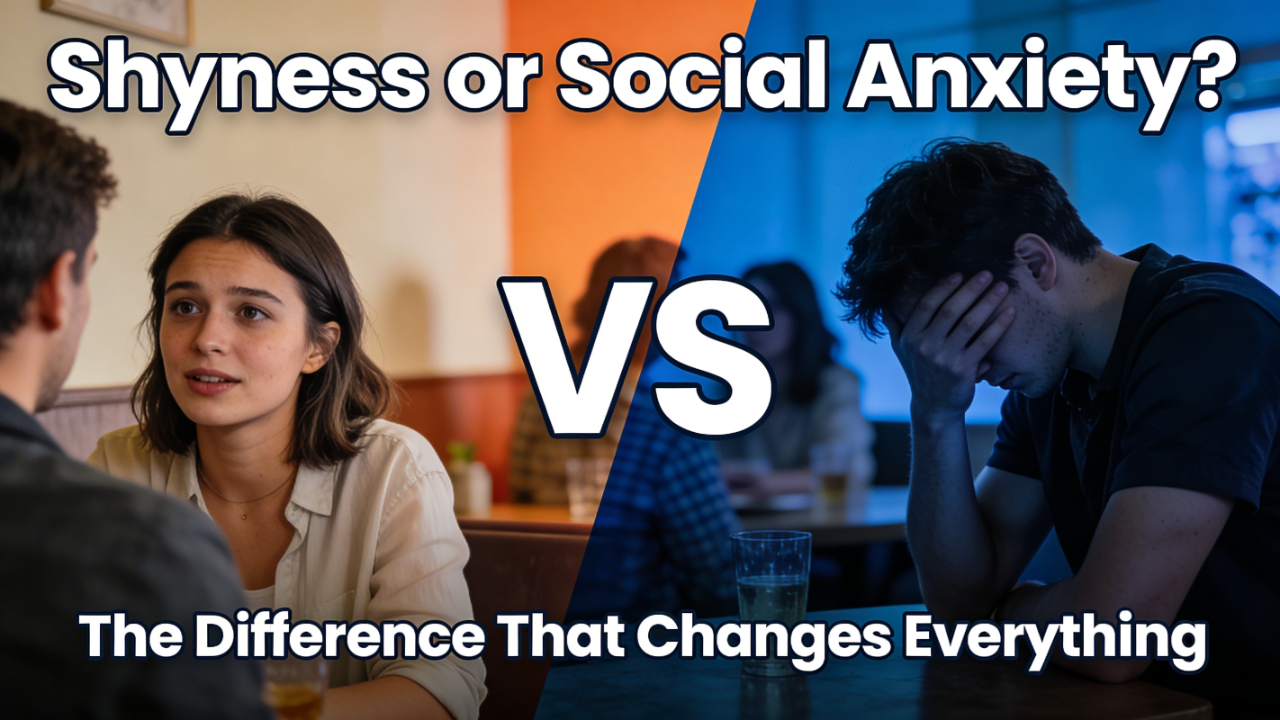
You're standing at a party, palms sweaty, heart racing, convinced everyone's judging you. Sound familiar?
Here's the million-dollar question: Is that just shyness, or is it social anxiety?
Understanding the difference isn't just semantic - it could literally change your life. If you've ever wondered whether what you're experiencing is normal discomfort or something more, this article will help you figure it out.
What Is Shyness?
Let's start with shyness, because it's incredibly common. We're talking about 40-50% of people identifying as shy at some point in their lives.
Shyness is fundamentally about temperament and personality. Shy people tend to:
- Feel uncomfortable in new social situations
- Be quiet and reserved
- Prefer smaller groups over large gatherings
- Take time to warm up to new people
But here's the critical distinction: shyness doesn't stop you from living your life.
A shy person might feel nervous before a work presentation, but they still do it. They might not love parties, but they'll attend the important ones. They might prefer one-on-one conversations, but they can function in groups when needed.
And crucially, shy people don't spend hours afterward analysing every word they said, convinced they made a complete fool of themselves.
What Is Social Anxiety Disorder?
Social anxiety disorder affects about 12% of people at some point in their lives. While less common than shyness, it's still remarkably prevalent.
And having helped hundreds of clients with this over my 12 years running Anxiety Specialists, I can tell you the difference is stark.
Social anxiety isn't just discomfort - it's fear.
Specifically, it's an intense fear of negative evaluation by others. Your brain is predicting that other people are going to judge you, reject you, or think you're stupid, boring, weird, or incompetent.
And this fear is so powerful that it fundamentally changes your behaviour.
The Brain Science: Your Amygdala on Social Threat
With social anxiety, your amygdala - the threat detection centre in your midbrain - has learned to treat social situations like genuine threats.
The same way it would respond to a sabre-toothed tiger, it's now responding to... a conversation with your neighbour.
So you get the full threat response:
- Your heart kicks it up a notch
- You get a bit clammy
- You start blushing
- Your mind goes blank
- You feel somewhat nauseous
Your body is preparing you to fight or flee from a predator, except the "predator" is just Karen from accounting asking about your weekend.
The Hallmark of Social Anxiety: Avoidance
Here's what really separates social anxiety from shyness: the avoidance.
People with social anxiety start avoiding situations that trigger their fear:
- Turning down promotions that involve presentations
- Skipping friends' weddings
- Ordering food online to avoid talking to restaurant staff
- Declining social invitations weeks in advance
And even when they do face social situations, they're using what we call "safety behaviours" - subtle avoidance strategies like:
- Rehearsing conversations in your head
- Avoiding eye contact
- Speaking very quietly
- Drinking alcohol to cope
- Staying glued to your phone
- Positioning yourself near an exit
You're trying to prevent the catastrophe your brain is predicting.
The Three Maintaining Factors
So what turns temporary anxiety into a persistent disorder? Three key maintaining factors:
1. Pre-Event Worry (Anticipatory Anxiety)
Before the event even happens, you're already imagining worst-case scenarios. Your brain is rehearsing failure.
And because your amygdala can't tell the difference between imagination and reality, this anticipatory anxiety triggers the same threat response as if the event was actually happening.
By the time you get to the actual social situation, you're already exhausted and primed for threat detection. This can start minutes, hours, days, or even weeks before an event.
Even if you go and it goes well, the amygdala thinks it went well because of all that worry-prep you did. So the cycle continues.
2. Safety Behaviours During the Event
When you use safety behaviours and nothing bad happens, your brain doesn't learn "Oh, social situations are actually safe."
Instead, it learns: "I only survived because I avoided eye contact and spoke quietly. Better keep doing that."
So the fear never gets corrected.
3. Post-Event Processing
After any social interaction, people with social anxiety spend hours - sometimes days - replaying the conversation in their head.
"Why did I say that? They definitely thought I was weird. I could see them looking at me strangely. I'm such an idiot."
This post-event processing strengthens the neural pathways associated with social threat. You're literally practicing anxiety.
When Has It Crossed the Line?
How do you know when it's moved from normal shyness into a problem that needs treatment?
Ask yourself these five questions:
1. Is it causing significant distress?
Are you suffering, rather than just uncomfortable?
2. Is it interfering with your life?
Are you turning down opportunities, avoiding important events, or limiting your relationships?
3. Is it persistent?
Has this been going on for six months or more?
4. Are you using avoidance or safety behaviours?
Are you working HARD to prevent something bad from happening?
5. Is it disproportionate?
Is your fear response way bigger than the actual threat?
If you answered yes to most of these questions, you're probably dealing with social anxiety disorder, not just shyness.
The Good News: Social Anxiety Is Highly Treatable
Here's what many people don't realize: social anxiety, like other anxiety disorders, is very treatable.
The research shows that psychological treatment has large effect sizes, meaning it's highly effective.
In my practice, I typically help clients overcome social anxiety in about 8-14 sessions, with most people seeing some improvement within 2-3 weeks.
How Treatment Works
The treatment works by:
- Gradually exposing you to feared social situations in a structured way
- Correcting the distorted thoughts that maintain the anxiety
We start small - maybe just making eye contact with a stranger - and progressively work up to more challenging situations like presentations or parties.
And critically, we do this without safety behaviours.
Because your brain needs to learn that social situations are safe on their own - not just safe when you're avoiding eye contact and rehearsing scripts.
Over time, your amygdala recalibrates. It learns that social evaluation isn't actually a life-or-death threat. The anxiety decreases. And you start living your life without that constant fear of judgment.
The Bottom Line
Shyness is a personality trait that causes mild discomfort but doesn't control your life.
Social anxiety is a disorder characterized by intense fear, avoidance, and safety behaviours that significantly interfere with your functioning.
If you're sitting there realizing, you might have social anxiety rather than just shyness - that's actually a good thing. Because it means there's a clear, evidence-based path forward.
You don't have to live with this fear forever.
Have you ever wondered whether your shyness was actually something more? If you're wanting help with Social Anxiety, check out my page on Social Anxiety.

