
How to Overcome Fear of Doctors and Hospitals (Iatrophobia)
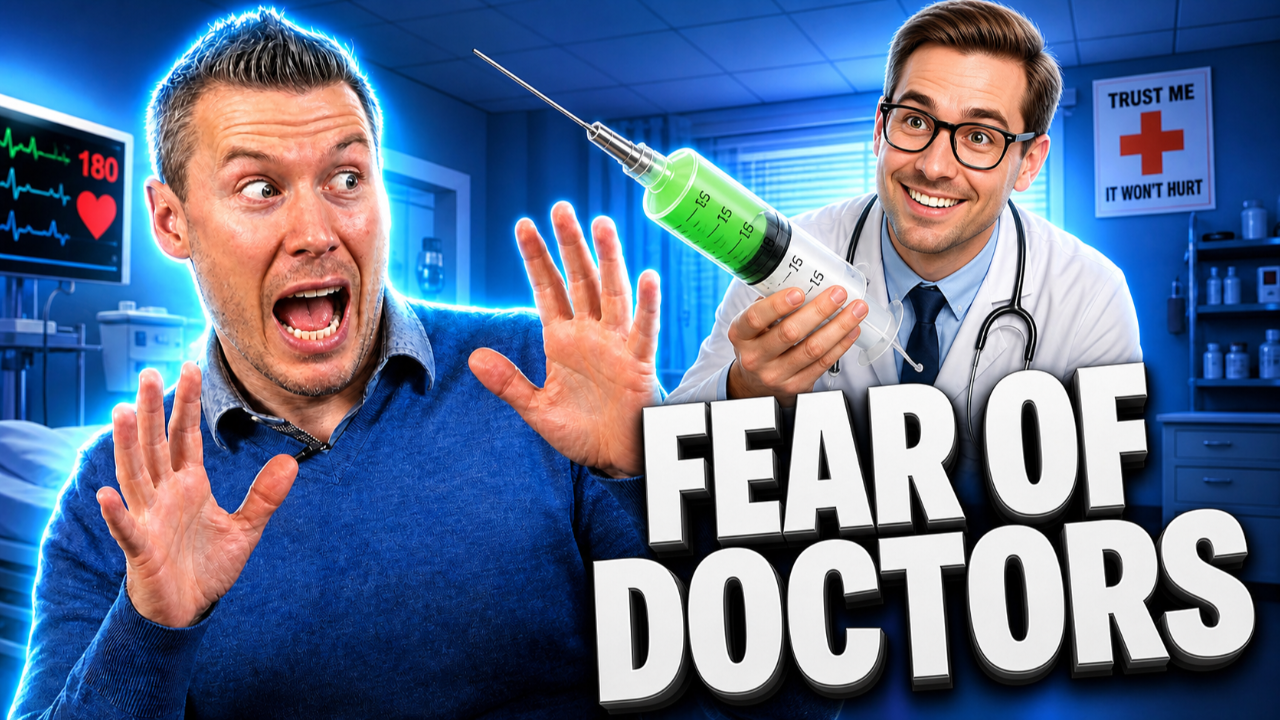
There's something you've been meaning to get looked at.
It's been there for a few weeks. Maybe longer. You know you should book an appointment. So instead, you Google it - which, predictably, doesn't help. You tell yourself you'll just keep an eye on it.
Eventually you book. And the moment that confirmation lands in your inbox, something shifts. That night you sleep badly. The day of, you feel it before you've left the house. By the time you're in the waiting room - fluorescent lights, names being called through the intercom - your heart is moving faster than it should be for someone just sitting in a plastic chair.
You know nothing bad is going to happen.
But that knowledge doesn't actually help. Does it.
If that's familiar, you're in the right place. This page covers what causes a fear of doctors and hospitals, why the usual advice doesn't fix it, and how to work through a complete virtual exposure therapy series - all free, all here.
What is the fear of doctors called?
The clinical term is iatrophobia. From the Greek "iatros" (physician) and "phobia" (fear).
If you've typed "what is the fear of doctors called" into a search engine and landed here - that's the answer. And the fact that you've been searching tells me something: you've recognised this in yourself, and you're looking for a way through it.
Research suggests somewhere between 5-10% of adults experience clinically significant medical anxiety. Think about a room of 50 people - 3 to 5 of them are quietly navigating the same thing you are.
And here's what makes iatrophobia different from most phobias.
Parks you can avoid. Flights, you can take the train. But medical care isn't optional. Not over a lifetime. Which means this one has a real-world cost that keeps accumulating the longer it goes untreated.
What does it actually look like?
In my clinic, it rarely looks the same from person to person.
Some people avoid booking altogether - putting off check-ups, not chasing test results, letting something they know they should get looked at sit there for months. Sometimes years.
Others book, then cancel. And rebook. And cancel again.
Some people make it to the waiting room and leave. They walk in, feel the anxiety rising, and walk back out. They tell themselves they'll try again next week.
For some, it's a specific part of the experience: the examination table, the medical gown, the equipment they don't understand, the way they forget half of what they planned to say the moment the doctor walks in.
For others, there's a contamination layer - the clinical smell, the sense that hospitals are where sick people go.
And for a lot of people, the biggest part is the loss of control. Medical settings are one of the few places in adult life where you genuinely aren't in charge of what happens. Other people have information you don't. Other people make decisions about you. You're often in a paper gown in a room full of equipment nobody has explained.
For a nervous system that uses predictability as a safety signal, that combination is a reliable anxiety trigger.
One thing worth saying plainly: most people with this fear haven't told many people about it. Because from the outside, it looks simple. Everyone goes to the doctor. And so the fear lives somewhere private, managed quietly, taking up more energy than anyone around you probably realises.
You weren't being difficult. You weren't being irrational. You were navigating something genuinely hard with very little support.
What causes iatrophobia?
There are 3 main pathways - and only one of them involves anything actually going wrong.
A direct negative experience. A procedure that hurt more than expected. A diagnosis delivered bluntly. A time you were dismissed, talked over, or left waiting without anyone explaining what was happening. One experience like that is enough for the midbrain to file medical settings under "threat" - and it stays filed there.
Modelling. If a parent or caregiver showed visible fear around medical appointments when you were growing up - bracing before examinations, expressing distrust of doctors, being visibly upset in hospitals - your brain learned from watching that. No direct experience required. Children are extraordinarily good at picking up threat signals from the adults around them. That's a survival mechanism. It just misfires here.
Loss of control. Some nervous systems are particularly sensitive to unpredictability. Medical settings deliver it systematically - you don't control the timing, the information, the procedure, or the outcome. For a brain wired to interpret uncertainty as risk, that adds up fast.
Knowing which pathway led here won't fix this on its own. But understanding it does something useful - it confirms the fear makes complete sense. It had a cause. Which means it has a solution.
Why telling yourself to calm down doesn't work
You have two parts of your brain doing very different jobs here.
Your prefrontal cortex - your thinking brain - knows a routine GP appointment isn't dangerous. You know that.
But the midbrain doesn't run on logic. It runs on pattern recognition and stored experience. It has associated medical settings with threat. And until it gets solid evidence to the contrary - not a logical argument, but actual experiential evidence - it keeps firing the alarm.
That's why telling yourself to calm down doesn't work. That's why having a completely reasonable conversation with yourself the night before still doesn't stop the dread. The midbrain doesn't take arguments. It takes experiences.
So the solution isn't to think differently about doctors.
It's to give the midbrain new experiences. Experiences of being around medical settings - or things associated with medical settings - and being safe. Do that consistently, at a manageable pace, and the midbrain updates its assessment. Medical settings go from "genuine threat" to "mildly uncomfortable at worst."
That process is called exposure therapy. And it works.
Is this phobia treatable?
Yes, absolutely.
A lot of people with this fear have been told to bring a support person, ask the doctor to be quick, or take something to take the edge off. That's not treatment. That's making avoidance more convenient - and avoidance is exactly what keeps the fear in place.
The treatment that works is structured, gradual exposure. You give the midbrain controlled, manageable doses of the feared stimulus, without anything catastrophic happening, until the threat response drops.
That's what the series below does.
The complete exposure therapy series
I've put together a full virtual exposure series for iatrophobia - 7 sessions that walk you through the process from the least activating stimulus to the most realistic virtual experience available.
Watch the main explainer first. Then work through the sessions in order, coming back to each one until it feels manageable before moving to the next. There's no timeline. Go at your own pace.
If you want anxiety reduction tools to use alongside the sessions, grab the free Anxiety Reducer Guide below - it covers exactly what to do so the anxiety spikes aren't riding so high, so you can stay in the exposure rather than retreating.
What Is Iatrophobia and How Do You Fix It?
Start here. This video covers the causes, the brain science, and exactly how the exposure process works before you begin.
Session 1 - Words
The smallest possible step. Words associated with doctors and hospitals appear on screen one at a time, 10 seconds each. For some people, this genuinely activates anxiety. That's exactly why we start here.
Rate your anxiety from 0 to 100% for each word. Come back until the words feel completely neutral before moving on.
Session 2 - Illustrated Images
Cartoon and illustrated images of doctors, hospitals, and medical settings. Drawn images, not photographs.
Your midbrain processes illustrated images differently from real ones - the threat response typically stays in a mild-to-moderate range, which is exactly where learning happens. This session is calibrated, not easy.
Rate your anxiety for each image. Come back until the images feel ordinary.
Session 3 - Real Photographs
Real photographs of medical settings - waiting rooms, examination rooms, doctors, equipment.
Photographs match the midbrain's stored threat templates in a way illustrated images can't. The update this session produces is more specific and more durable.
Some images will spike your anxiety more than others. That variation is useful information. Stay with them.
Session 4 - Medical Sounds
The hospital intercom. The blood pressure cuff inflating. The ambient clinical environment. For a lot of people, this is the hardest session in the series.
There's a neurological reason for that. Your auditory system processes threat signals faster than your visual system - a sound can trigger a full anxiety response before your eyes have identified what they're hearing. Understanding this helps you stay in the session when it's difficult.
Session 5 - Animated Videos
Moving illustrated content - animated characters in medical settings, drawn walk-throughs of appointments.
Still images let the midbrain fully assess what's in them. Video removes that. The moment something starts moving, the midbrain shifts from assessment mode to prediction mode - a different layer of the fear response that photographs and sounds alone don't activate.
Animated content keeps this at a manageable level. But the motion is real enough to work with.
Session 6 - Real Video Footage
Actual footage of actual medical settings. The illustrated buffer disappears here.
Your midbrain's threat templates were built from real experiences - and real footage matches them in a way animated content simply can't. This session is the pivot point of the series.
Stay with the footage. Don't look away. Come back until it feels familiar rather than alarming.
Session 7 - Audio and Visual Combined
The final virtual step. Real footage with full ambient audio running alongside it - the intercom, the clinical environment, footsteps, doors, the ordinary sounds of a medical appointment arriving all at once.
Every previous session separated the sensory channels. Real appointments don't work that way. This session closes the gap between virtual exposure and the real thing.
When this feels manageable, you're ready for real-world exposure - walking into an actual clinic.
What comes after the series?
When Session 7 feels manageable, the next step is real-world exposure. That means taking what you've built here into actual medical settings - a walk past a clinic, sitting in a waiting room, booking and attending an appointment.
You don't need your anxiety to be zero before you do that. You just need to go - and stay.
If you have questions about the process or want to work through this with support, you can find out more about working with me here.

