
Why Social Anxiety Makes You Think Everyone's Judging You (They're Not)
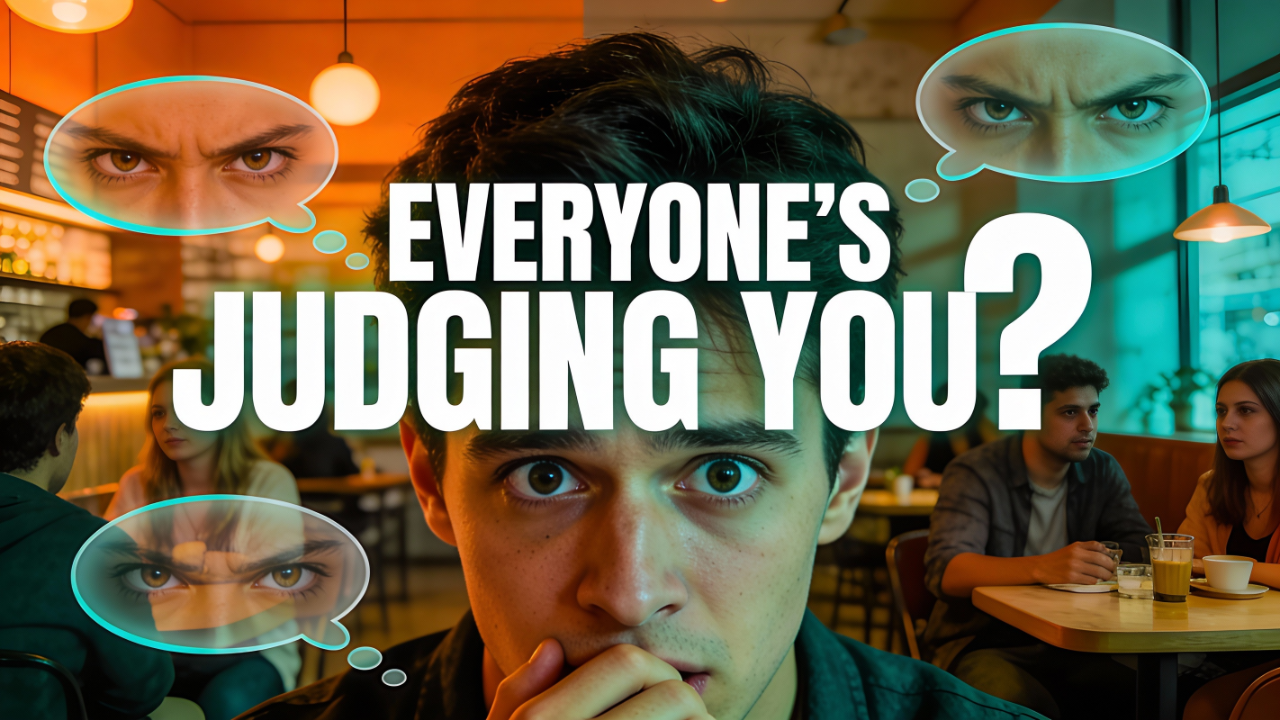
Have you ever walked into a room and immediately felt like everyone turned to look at you? Or said something in a conversation and then spent the next three hours replaying it, convinced you sounded like an idiot?
Maybe you avoid speaking up in meetings because you're certain people will think your ideas are stupid. Or you cancel plans with friends because the thought of being in a social situation makes your heart race and your palms sweat.
If any of this sounds familiar, you're not alone.
Social anxiety affects about 12% of people at a clinical level at some point in their lives. That's roughly 1 in 10 people, and the number is much higher when you factor in sub-clinical struggles with this common anxiety. The core feature of social anxiety is this overwhelming belief that other people are watching you, evaluating you, and forming negative judgments about you.
But here's the thing. They're not.
And I don't mean that in a dismissive way. I mean your brain is running a threat-detection programme that's fundamentally misevaluating the situation. It's treating other people's possible judgements of us as if they're both definitely happening and catastrophically important.
What Happens in Your Brain During Social Anxiety
Your amygdala - that's the almond-shaped structure in your midbrain - is constantly scanning for threats. That's its job. It's been doing this for millions of years, and it's kept our species alive.
But here's what's interesting. For our prehistoric ancestors, one of the biggest threats wasn't predators or starvation. It was social rejection.
If you got kicked out of your tribe 50,000 years ago, you died. You couldn't hunt alone. You couldn't defend yourself from predators. You couldn't survive winter without the group.
So your brain evolved to treat social rejection like a life-or-death emergency. Which is why even today, the thought of someone judging you negatively can trigger the exact same physiological response as if you were being chased by a predator.
Your amygdala fires danger signals. Your adrenal glands dump adrenaline and cortisol into your bloodstream. Your heart rate spikes. Your breathing gets shallow. Blood rushes to your face - that's the blushing. Or it drains away - that's the going pale.
You start sweating. Your hands shake. You might feel dizzy or lightheaded. Your mouth goes dry. And your prefrontal cortex - the logical thinking part of your brain - partially shuts down because all your resources are being diverted to survival mode.
This is a full-blown threat response - over the possibility of someone thinking you're awkward.
The Spotlight Effect
The core problem is something psychologists call the "spotlight effect." You feel like there's a spotlight on you, highlighting every flaw, every mistake, every awkward thing you say or do.
But the reality is, everyone else is just going about their day. They're thinking about their own problems, their own insecurities, their own to-do lists. They're not conducting detailed evaluations of your performance.
Let me give you an example. One of my clients - let's call her Emma - wouldn't eat in public. Restaurants, cafes, even lunch at work. She'd make excuses or eat in her car.
When we unpacked it, her belief was: "If I eat in front of people, they'll watch how I chew. They'll think I look weird or disgusting. They'll judge me."
So I asked her: "When you're in a restaurant, do you watch other people eat and judge how they chew?"
"No," she said.
"Do you even notice how other people eat?"
"Not really. I'm usually thinking about my own food or talking to whoever I'm with."
That's the key insight. Everyone else is wrapped up in their own experience. They're not paying attention to you the way you think they are.
But when you have social anxiety, you believe they are. You believe you're the centre of attention - and in a bad way. You believe people are noticing everything about you and forming negative judgments.
The Three Maintaining Factors
Why does your brain create this false belief that everyone's watching and judging? It comes down to three factors.
1. Hypervigilance to Threat Cues
When you walk into a room, your amygdala is scanning for signs of danger. And because it's primed to detect social rejection, it picks up on tiny things - a glance, a pause in conversation, someone's facial expression - and interprets them as evidence of negative judgment.
Someone looks at you for a split second. Your brain says: "They're staring. They think I look weird."
Someone doesn't laugh at your joke. Your brain says: "They think I'm boring. They don't like me."
Someone leaves the conversation early. Your brain says: "I said something wrong. They can't stand being around me any longer."
But none of these interpretations are necessarily true. The person might have just been looking around the room. They might not have heard your joke. They might have needed to take a phone call.
Your amygdala is making assumptions based on incomplete information. And those assumptions always skew negative because its job is to keep you safe, not to be accurate. Better safe than sorry is the amygdala's motto.
2. Intensive Self-Focus
When you're anxious in social situations, your attention turns inward.
You're hyperaware of your own thoughts, your own sensations, your own behaviour. You're monitoring yourself constantly. "Am I talking too much? Am I being boring? Do I look nervous? Can they tell I'm sweating?"
This is also based on your pre-conceived idea of who you are and how you look. Your self-image. The you you think others see and interact with.
This creates a feedback loop. The more you focus on yourself, the more awkward you feel. The more awkward you feel, the more you focus on yourself - to try to get an idea of what they're seeing so you can appearance manage and stem the tide of judgement.
And because you're so focused on your own experience, you assume everyone else is too, and what they're seeing is the you that you see in your head. But they're not. They experience their own version of you. Often one laced with less negative judgement.
3. Post-Event Processing
After a social interaction, you replay it over and over in your head. You analyse everything you said and did. You look for evidence that you embarrassed yourself. This is sometimes called a post-mortem, as you dissect the corpse of your memory of the events.
And here's the problem. Your memory is biased. When you're anxious, you remember the awkward moments and forget the normal parts. You remember the one time you stumbled over your words and ignore the 20 minutes of smooth conversation.
This strengthens your belief that you performed badly. Which makes you more anxious next time. Which makes you more likely to focus on the awkward moments. And the cycle continues.
How I Help Clients Overcome Social Anxiety
In my 12 years running Anxiety Specialists, I've personally seen people for almost 10,000 face-to-face sessions. And I can tell you that social anxiety is one of the most common presentations I see.
But it's also one of the most treatable. The research shows that cognitive behavioural therapy combined with exposure therapy has a really high rate of positive sustained change for social anxiety. Most of my clients see significant improvement within 8-14 sessions.
And I know this works because I used these exact techniques on my own social anxiety. I struggled with picking up phone calls from unknown numbers. I'd try to guess who it was or what I would say, what they might think of me and end up answering too late. But I worked through it systematically, and now I hardly miss any phone calls.
I still get a little nervous sometimes. But it's manageable. It doesn't stop me.
Here's how I help clients break free from social anxiety:
Step 1: Challenge the Beliefs
We identify the specific thoughts: "People will think I'm stupid." "Everyone's looking at me." "If I blush, they'll judge me." "I'll say something embarrassing and they'll remember it forever."
Then we examine the evidence. Is there actual evidence for these thoughts? Or are they assumptions?
For Emma, we looked at the evidence that people were judging how she ate. Had anyone ever commented on it? No. Had anyone ever stared at her while she ate? Not that she could recall. Had she ever judged someone else for how they ate? No.
So we established that the belief was an assumption, not a fact.
Step 2: Address the Spotlight Effect
I get clients to do exercises where they test their assumptions. They go out and do something mildly attention-getting - like wearing a t-shirt with a funny slogan, or asking a shopkeeper an unusual question - and then they observe how little people actually care.
They discover that even when you do something noticeable, people forget about it almost immediately. Because people are self-focused. They're thinking about their own lives.
Step 3: Exposure Therapy Without Safety Behaviours
This is really important. I gradually expose clients to the situations they've been avoiding, without using safety behaviours.
Safety behaviours are the subtle things you do to try to prevent the feared outcome. Like speaking quietly so people don't focus on you. Or avoiding eye contact. Or rehearsing everything you say before you say it. Or having a few drinks before social events.
The problem with safety behaviours is they reinforce the belief that the situation is dangerous. "I only got through that meeting because I didn't speak up much." This prevents you from learning that you can handle the situation without the safety behaviour.
For Emma, we did systematic exposure. First, we worked through virtual exposure - imagining herself eating in a restaurant, looking at photos of people eating, watching videos.
Then we progressed to real-world exposure. Starting small - eating a snack on a park bench. Then a quiet cafe. Then a busier cafe. Then a restaurant with a colleague.
At each stage, she learned that nothing catastrophic happened. People weren't staring at her. Nobody commented on how she ate. Life went on normally.
And over about 12 sessions, she went from eating alone in her car to comfortably having lunch with colleagues every day. The anxiety didn't vanish completely - some situations still made her a bit nervous - but it reduced by about 70%.
She got her life back.
My Personal Experience with Social Anxiety
I mentioned I struggled with social anxiety around phone calls. And I can tell you from personal experience that the thing that changed it for me wasn't telling myself "they're not going to judge you." That didn't work.
What worked was exposure. I picked up the phone without giving myself time to think - no safety behaviours. Each time, I proved to my amygdala that I could survive it, nothing bad ended up happening. No difficult questions I couldn't answer, no yelling at me down the phone. Just normal conversations.
I even took it further and deliberately put myself in public speaking situations. Panels. Presentations at conferences. Being on YouTube.
And each time, I noticed that people weren't scrutinising me the way I thought they were. They were just listening. Or not listening and thinking about their own stuff. But they weren't forming detailed negative judgments about me.
The Key Insight
Your brain is treating imagined judgment as if it's both certain and catastrophic. But it's neither.
Most of the time, people aren't judging you at all. They're too busy thinking about themselves.
And even when someone does form a negative judgment - which happens sometimes, let's be honest - it's not catastrophic. Someone could meet you at a party, think you're a bit awkward, and never think about you again. That's not the end of the world. That's just life.
Not everyone's going to love you. And that's okay.
The goal isn't to never feel anxious. The goal is to feel the anxiety and do the thing anyway. To realise that the anxiety is based on a misevaluation - you're overestimating both the probability of negative judgment and the importance of that judgment even if it happens.
Moving Forward
Social anxiety makes you think everyone's judging you because your brain is treating social rejection like a life-or-death threat. But the reality is, most people are too focused on themselves to be judging you. And even when they do judge, it matters far less than you think.
The way forward is to challenge those beliefs, test them in the real world through exposure, and discover that you can handle social situations without catastrophe.
If you struggle with social anxiety and you want help with this, check out our social anxiety resources to get your first steps to overcome it.

